


India's public hospitals face unprecedented healthcare challenges. Nurse-to-patient ratios often exceed 1:30, five times the WHO-recommended standard of 1:6. In this environment, the traditional practice of manual vital signs monitoring every 4-6 hours leaves dangerous gaps in patient surveillance, with research showing that up to 67% of adverse events go undetected in general wards. When patient deterioration slips through these gaps, the consequences cascade: worsening outcomes, emergency ICU transfers, and exponentially rising costs.
AI-enabled early warning systems built on remote patient monitoring (RPM) technology are emerging as a critical solution for India's overburdened public healthcare infrastructure. These systems don't just enhance care; they may be essential to the survival of the public hospital system itself.
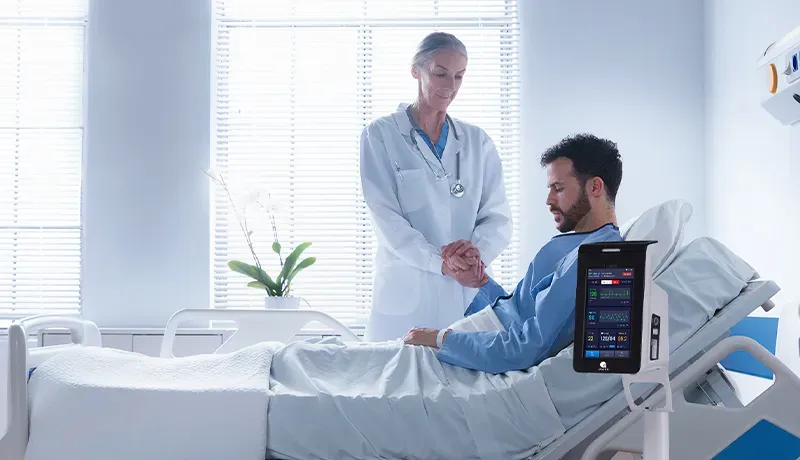
Understanding AI-Based Early Warning Systems
Traditional Early Warning Systems (EWS) like the Modified Early Warning Score (MEWS) or National Early Warning Score 2 (NEWS2) rely on intermittent manual vital signs collection and scoring. While valuable, their effectiveness is limited by the frequency and accuracy of data collection. AI-based early warning systems represent a paradigm shift. By integrating continuous remote patient monitoring with machine learning algorithms, these systems provide:
- Continuous surveillance through non-invasive technologies like ballistocardiography (BCG)
- Multi-parameter tracking, including heart rate, respiration rate, SpO₂, temperature, and non-contact blood pressure (NcBP)
- Predictive analytics that generate alerts 8-16 hours before clinical deterioration becomes apparent
- Seamless integration with existing hospital information systems
Critically, these systems monitor patients without physical contact, eliminating sleep disruption and reducing infection risk while freeing nursing staff for direct patient care.
Challenges in Indian Public Hospitals
Severe Nursing Shortages India faces a shortfall of over 2.4 million nurses. This workforce gap directly translates to compromised patient safety and quality of care across the public hospital system.
The Failure of Manual Monitoring When nurses can only perform vital signs checks every 4-6 hours, subtle warning signs of deterioration, gradual respiratory decline, early sepsis indicators, or cardiac instability often go unnoticed until a crisis occurs.
ICU Capacity Constraints With only 5-10% of hospital beds equipped as ICU-capable facilities, any preventable escalation from general wards creates bottlenecks that compromise care for all critical patients. Tertiary care centers face overwhelming demand that could be substantially reduced through earlier intervention.
Economic Pressures ICU admissions cost 5-6 times more than ward care. For resource-constrained public hospitals, preventing even a small percentage of ICU transfers delivers significant cost savings that can be redirected to other critical needs.
Regulatory Requirements National Accreditation Board for Hospitals (NABH) standards and Ayushman Bharat Digital Mission (ABDM) frameworks increasingly mandate robust patient safety protocols, digital health records, and demonstrable continuity of care, requirements difficult to meet through manual systems alone.
How AI-Based EWS Addresses These Challenges
Transforming Every Bed Into a Smart Bed Automated continuous monitoring ensures comprehensive surveillance across all ward beds without requiring additional staff deployment or workflow disruptions.
Enabling Proactive Clinical Intervention Research at King George's Medical University (KGMU) demonstrated that Dozee's AI-powered RPM system provided alerts an average of 16 hours before clinical deterioration, with 94% sensitivity in detecting adverse events. This advance warning creates crucial time windows for intervention before conditions become critical.
Optimizing Nursing Workflows Clinical studies document an average of 2.5 hours saved per nurse per shift—time that can be redirected from routine vital signs documentation to direct patient assessment, medication administration, and family communication.
Reducing Preventable ICU Escalations Wockhardt Hospitals reported a 50% reduction in emergency ICU admissions following Dozee deployment, demonstrating how early detection and intervention can prevent deterioration before ICU-level care becomes necessary.
Building Trust Through Transparency Apollo Hospitals noted marked improvements in family satisfaction, as the system enables timely, data-driven communication about patient condition and treatment responses.
Evidence From Indian Healthcare Institutions
King George's Medical University, Lucknow A retrospective cohort study of over 700 patients demonstrated alerts up to 16 hours before deterioration events, 94% detection sensitivity, and 10% reduction in nursing documentation time—translating to 4.8 hours saved per nurse weekly.
Wockhardt Hospitals (Mumbai, Nagpur, Rajkot) Multi-center implementation yielded an 83% reduction in time spent on manual vital signs collection, 50% fewer emergency ICU transfers, and zero patient falls over six months—a remarkable safety achievement.
Ramaiah Memorial Hospital, Bengaluru A peer-reviewed study published in the Journal of Medical Internet Research confirmed 97% sensitivity in detecting patient deterioration, with alerts averaging 18 hours before ICU transfer became necessary.
Apollo Hospitals Initial cardiac ward pilots demonstrated sufficient impact to justify expansion across multiple centers, showing measurable improvements in patient outcomes, nursing efficiency, and family engagement metrics.
Strategic Benefits for Public Hospitals
Enhanced Patient Safety: Continuous monitoring dramatically reduces "failure-to-rescue" events—situations where treatable deterioration progresses to serious complications due to delayed detection.
Operational Efficiency: Automated vital signs documentation and trend analysis eliminate repetitive manual tasks, allowing nurses to function at the top of their licensure.
Financial Sustainability: Preventing just 5% of ICU admissions in a 500-bed hospital can generate annual savings exceeding ₹2-3 crores, creating a compelling return on investment.
Policy and Accreditation Alignment: AI-based EWS systems support NABH accreditation requirements, facilitate ABDM integration through digital health records, and advance Ayushman Bharat's vision of technology-enabled universal healthcare.
Equitable Healthcare Access: Cloud-based architecture and minimal infrastructure requirements enable deployment in tier-2 and tier-3 hospitals, extending advanced monitoring capabilities beyond metropolitan tertiary centers.
The Path Forward
The Digital India Health Mission and ABDM framework are creating the infrastructure necessary for AI-enabled healthcare to scale nationwide. As public hospitals digitize patient records and connect to the national health stack, AI-based early warning systems like Dozee represent the natural next step, transforming raw clinical data into actionable intelligence that saves lives.
The question is no longer whether AI belongs in Indian public hospitals, but how quickly it can be scaled to reach the patients who need it most.
Conclusion
AI-driven early warning systems have evolved from promising technology to a public health necessity. They address the most pressing challenges facing Indian public hospitals: chronic understaffing, patient safety gaps, ICU capacity constraints, and cost pressures. The evidence from KGMU, Wockhardt, Ramaiah Memorial, and Apollo Hospitals demonstrates not just feasibility but a measurable, significant impact.
For India's public hospital system to meet the healthcare needs of 1.4 billion people, innovation is not optional. AI-based early warning systems represent one of the most promising tools available to bridge the gap between current reality and the care every patient deserves. The technology exists. The evidence is compelling. What remains is the will to implement it at scale.
Frequently Asked Questions
What makes AI-based early warning systems superior to manual monitoring?
AI-based systems provide continuous vital signs tracking and use machine learning algorithms to detect subtle patterns of deterioration hours before they become apparent through intermittent manual checks. This continuous surveillance eliminates the monitoring gaps that occur with 4-6 hour check intervals.
Are these systems financially viable for resource-constrained public hospitals?
Yes. The cost savings from preventing ICU transfers, reducing length of stay, and improving nursing efficiency typically exceed implementation costs within the first year. Additionally, improved patient outcomes reduce liability and reputational risks.
Can AI-based EWS function in rural or resource-limited settings?
Absolutely. Dozee's contactless sensor technology requires minimal infrastructure—only a bed, power source, and internet connectivity. Cloud-based dashboards can be accessed from any device, making the system suitable for district hospitals and community health centers.
What training do clinical staff require?
Minimal. The systems integrate with existing nursing workflows and hospital information systems. Most facilities report that 2-3 hours of orientation is sufficient for staff to become proficient with the technology.
How quickly can hospitals expect to see measurable results?
Institutions like Wockhardt Hospitals and KGMU documented significant improvements in patient safety metrics, nursing efficiency, and ICU utilization within the first six months of deployment.
References
Lakshman, P., Gopal, P. T., & Khurdi, S. (2025). Effectiveness of Remote Patient Monitoring Equipped With an Early Warning System in Tertiary Care Hospital Wards: Retrospective Cohort Study. Journal of Medical Internet Research, 27(1), e56463. https://doi.org/10.2196/56463
Yadav, A., Dandu, H., Parchani, G., Chokalingam, K., Kadambi, P., Mishra, R., Jahan, A., Teboul, J. L., & Latour, J. M. (2024). Early detection of deteriorating patients in general wards through continuous contactless vital signs monitoring. Frontiers in Medical Technology, 6, 1436034. https://doi.org/10.3389/fmedt.2024.1436034