


Patient monitoring is the backbone of safe and effective hospital care. In India’s resource-strained healthcare environment, where the nurse-to-patient ratio in India is often 1:588, while the WHO recommends 1:333, the choice of monitoring method has direct implications on patient safety, staff efficiency, and hospital economics.
While traditional patient monitoring methods rely on periodic spot checks, AI in patient monitoring introduces continuous, automated, and predictive insights. This blog compares the performance of traditional systems with AI-powered remote patient monitoring systems (RPM devices), focusing on outcomes proven in Indian hospitals.
What is Traditional Patient Monitoring?
Traditional monitoring in general wards involves:
- Manual spot checks of vitals (HR, RR, BP, SpO₂, temperature) every 4-6 hours.
- Calculation of Modified Early Warning Score (MEWS) based on intermittent values.
- Reliance on nurse documentation and escalation when deterioration is detected.
Limitations:
- Changes in vitals between the spot checks are often missed.
- Delayed recognition of deterioration can lead to unplanned ICU admissions.
- High nursing workload; up to 50 minutes per patient daily is spent on vitals charting.
What is AI-Powered Monitoring?
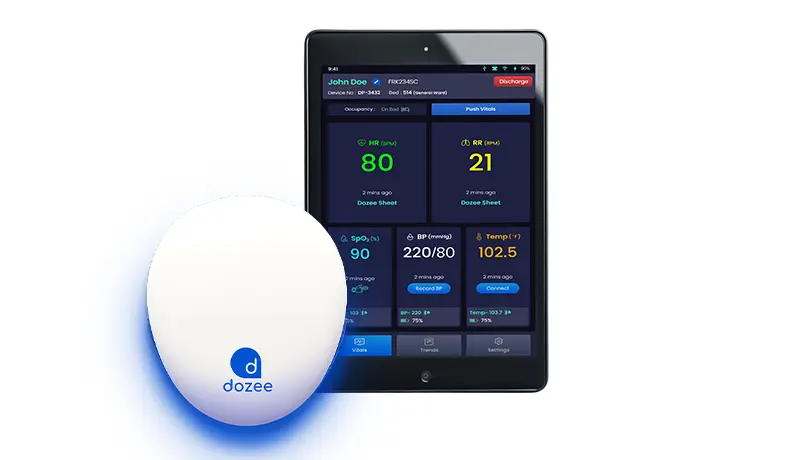
AI-powered remote health monitoring systems like Dozee use contactless health monitoring technology (ballistocardiography sensors under the mattress) to continuously capture HR, RR, BP, and more. Data is analysed in real time to generate an Early Warning Score (EWS).
Key features:
- Continuous, contactless vitals monitoring.
- Automated risk stratification (NEWS2, MEWS, DEWS).
- Remote dashboards for centralised command centres.
- Smart alerts that are more specific and trigger 8-16 hours before deterioration.
Performance Metrics: AI vs Traditional
Proven Impact in Indian Healthcare Settings
- KGMU Lucknow: Continuous contactless monitoring detected deterioration 16 hours in advance, with sensitivity up to 94%.
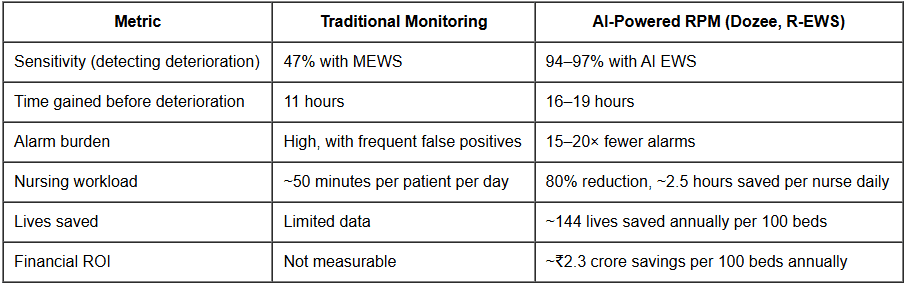
- Ramaiah Memorial, Bengaluru: Retrospective study on 905 patients showed AI-based RPM identified deterioration with 97% sensitivity, compared to 47% with MEWS.
- Apollo Hospitals: AI monitoring reduced nurse workload, improved efficiency, and enabled regular updates to patient families.
- Dozee’s Million ICU Initiative: Over 6,600 beds upgraded in 323 hospitals; estimated savings of ₹2,150+ Cr if scaled across public healthcare.
Key Benefits of AI-Based Monitoring
- Early detection: Identifies risk 8-19 hours before clinical deterioration.
- Workforce efficiency: Saves ~2.5 nursing hours per day, per nurse.
- Cost savings: ~₹2.3 Cr saved annually per 100 beds.
- Better patient outcomes: Fewer ICU transfers, shorter stays (0.7–1.3 days reduced).
- Contactless safety: Minimises infection risk during pandemics.
- Scalability: Rapid 15-minute setup; usable in district and rural hospitals.
Challenges and Considerations
- Initial investment in hardware/software.
- Training required for nurses and doctors.
- Integration with existing HIS/EHR systems.
- Alarm fatigue risk if thresholds are not well-tuned.
- Data privacy and security, managed through ISO 27001:2022 certified systems.
Conclusion
The comparison is clear: AI-powered monitoring outperforms traditional methods across sensitivity, timeliness, workload reduction, and ROI. For Indian hospitals operating under resource constraints, solutions like Dozee’s remote patient monitoring RPM devices offer a scalable path to safer, more efficient, and cost-effective healthcare. The future of patient care in India lies not in doing more of the same, but in doing smarter, with AI, automation, and connected health systems leading the way.
FAQs
What is the difference between AI-powered and traditional patient monitoring?
Traditional monitoring uses manual, periodic checks. AI-powered systems provide continuous, automated, and predictive monitoring with early alerts.
Is AI-based monitoring safe for patients?
Yes. Dozee uses validated, CE-marked, and ISO-certified contactless technology.
Can AI-powered monitoring reduce ICU admissions?
Yes. Studies show fewer unplanned ICU transfers and shorter ICU stays, saving up to 144 lives annually per 100 beds.
How accurate is AI in monitoring patient vitals?
Clinical studies report up to 97% sensitivity in detecting deterioration.
Does AI replace doctors or nurses?
No. AI augments clinical teams by automating routine monitoring, freeing staff for critical care tasks.
How is data from AI-based systems stored and secured?
Data is encrypted and stored on ISO 27001:2022 certified systems with EHR/HIS integration.
Is contactless monitoring better than wired systems?
Yes. It reduces infection risk, improves patient comfort, and enables mobility.
What are the costs involved in adopting AI monitoring?
While initial costs exist, hospitals save ~₹2.3 Cr annually per 100 beds through reduced ICU use and nursing efficiency.
Can AI-based RPM systems work in smaller hospitals or rural areas?
Yes. Devices can be installed in 15 minutes and require minimal training, making them ideal for resource-limited settings.
How do hospitals transition from traditional to AI-powered monitoring?
Hospitals often start with select wards, integrate the system with existing HIS/EHR, train staff, and gradually scale across departments.