


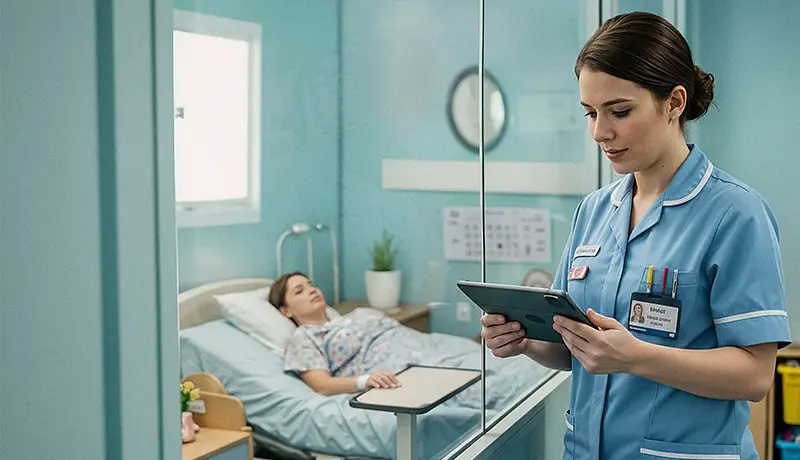
Why hospital patient safety is critical
Patient safety is no longer a compliance checkbox—it is a strategic imperative. In India, nearly 67% of adverse events in general wards go unnoticed under traditional spot-check monitoring. With stretched nurse-to-patient ratios (1:588 vs WHO’s 1:333), the risk of delayed intervention is high.
This is where contactless patient monitoring powered by AI offers hospitals a chance to transform outcomes. The Dozee monitoring system continuously tracks vitals under the mattress, issues smart alerts, and integrates with hospital IT systems—helping clinicians improve patient safety in hospitals without adding staff burden.
Feature 1 – Early Warning System: triage & alerts
Dozee’s Early Warning System (EWS) uses AI to detect subtle deterioration trends up to 16–19 hours before critical events.
- Alerts are tiered (low, medium, high) for rapid triage.
- Integration with NEWS/MEWS ensures clinical familiarity.
- Helps avoid unplanned ICU transfers, enabling proactive escalation.
This early-action advantage is a game-changer in settings where ward patients may otherwise deteriorate silently.
Feature 2 – Alarm fatigue management: customizable thresholds
Traditional hospital bed monitoring systems often overwhelm staff with alarms. In contrast, Dozee’s AI filters noise, delivering 15–20x fewer alerts than standard monitors.
- Customizable thresholds reduce false positives.
- Smart alerts highlight only clinically significant deviations.
- Fewer unnecessary interruptions mean staff attention is focused on true emergencies.
This approach reduces alarm fatigue while keeping patient safety central.
Feature 3 – Automation & integration: Secure RPM + HIS
Dozee’s hospital bed tracking system is designed to integrate seamlessly with HIS/EHR platforms.
- Automated vitals charting eliminates manual errors.
- SecureRPM technology is ISO 27001:2022 and HIPAA compliant.
- Real-time dashboards connect beds across wards, creating a central command view.
Such automation ensures regulatory compliance and enables hospitals to align with global digital health trends.
Feature 4 – Nursing time saved: quantify saving
Manual vitals checks consume up to 50 minutes per patient daily. By digitizing and automating, Dozee helps nurses save:
- ~2.5 hours per nurse per day in KGMU Lucknow studies.
- 83% reduction in vitals documentation time at Wockhardt Hospitals.
This time is redirected to direct patient care, easing workforce stress in nurse-short India.
Feature 5 – Continuous data: sleep, HR, respiration
Unlike intermittent spot checks, Dozee continuously tracks HR, respiration, SpO₂, BP, and even sleep quality.
- Detects deterioration trends that intermittent checks miss.
- Provides longitudinal patient records for better decision-making.
- Helps identify risks such as apnea or fall-risk in advance.
This continuous dataset strengthens clinical governance and patient outcomes.
Case studies: mention BM Birla/Breach Candy adoption
Leading Indian hospitals have already deployed Dozee:
- BM Birla Heart Research Centre, Kolkata adopted Dozee for post-cardiac surgery monitoring, improving patient safety and nurse efficiency.
- Breach Candy Hospital, Mumbai deployed Dozee’s contactless monitoring system across wards, helping clinicians detect deterioration early and improve family satisfaction.
Together with networks like Apollo and Wockhardt, these hospitals prove that Dozee is not a pilot innovation—it is a scalable standard of care.

Conclusion: scale across wards
To truly improve patient safety in hospitals, AI-powered, contactless patient monitoring must move beyond ICUs into general wards. Dozee enables this scale by combining clinical accuracy, seamless integration, and cost-savings.
For hospitals navigating resource constraints yet aspiring to global standards, Dozee is more than a monitoring device—it is a strategic investment in safer, smarter care.
FAQs
Which method is used to monitor patient safety?
Traditionally, safety is monitored through spot checks and manual documentation. With RPM, continuous and automated monitoring ensures timely detection of deterioration.
What are the advantages of patient monitoring?
Improved safety, timely interventions, reduced ICU transfers, and better patient satisfaction.
Are current wireless monitoring systems capable of detecting adverse events in high-risk surgical patients?
Yes. Studies at KGMU and Ramaiah Memorial confirm Dozee’s EWS identified deterioration with 97% sensitivity, far better than traditional MEWS at 47%.
What are the benefits of RPM?
Early detection of deterioration, reduced nurse workload, fewer unplanned ICU admissions, and cost savings of ~₹2.3 Cr annually per 100 beds.
How to improve patient safety?
Adopting AI-driven remote patient monitoring devices like Dozee helps detect risks early, reduce alarm fatigue, and enable proactive care—key to safer hospitals.